How we measure carbon in coffee farms
Last updated: April 2026
Methodology
Very little research exists on carbon storage in subtropical tree stocks like coffee. Until F.O.C.U.S.™, there were no allometric equations for coffee trees — making accurate carbon measurement in coffee farms impossible. F.O.C.U.S.™ solved this by sampling and measuring coffee trees directly to build bespoke equations calibrated for coffee agroforestry. Combined with satellite remote sensing and soil organic carbon sampling, it provides a dual measurement approach that no other standard can offer for coffee.
At a Glance
- Above-ground carbon: Satellite remote sensing with bespoke allometric equations developed by sampling and measuring coffee trees directly — calibrated specifically for coffee agroforestry, not adapted from generic forestry models
- Below-ground carbon: Spectral analysis baselines + Loss on Ignition (LOI) monitoring at 30cm depth
- Carbon stock formula: Bulk Density × SOC Content × Soil Depth = carbon per hectare (IPCC methodology)
- Approach: Carbon insetting — sequestering new carbon within coffee supply chains, not just preventing emissions
- For coffee companies: Scope 3 emissions represent up to 90% of a coffee company's total footprint. F.O.C.U.S.™ addresses this at the farm level
Overview
The F.O.C.U.S.™ methodology is built around four stages: data collection, satellite measurement, soil measurement, and verification. Each stage contributes to a complete above-ground and below-ground carbon account for participating farms.
The approach was developed over 13 years of direct work with smallholder coffee farming communities in East Africa, and launched in 2022 with support from the European Space Agency (ESA) Business Applications programme.
Stage 1: Data Collection and Farm Mapping
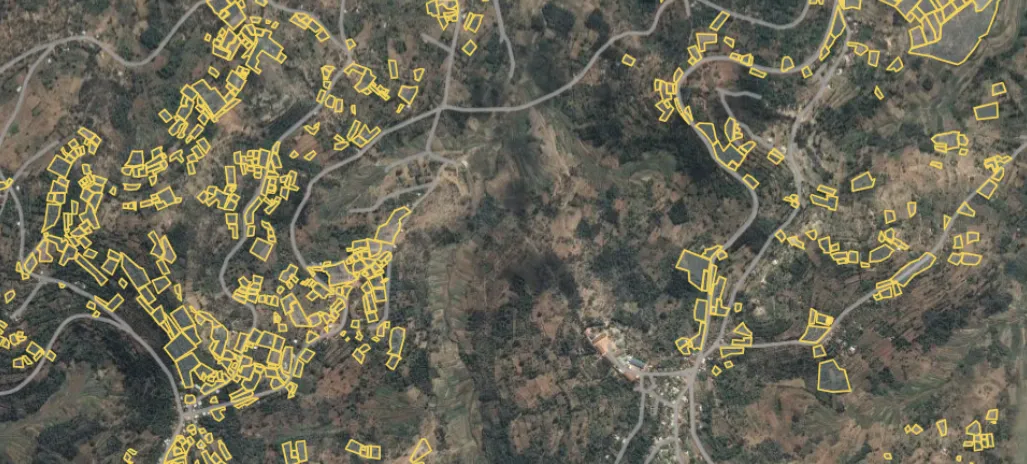
The first stage uses a mobile mapping application to establish the physical boundaries of each participating farm. The app works offline and uses geo-referenced data collection to accurately map individual plots.
During this stage, field surveyors also record:
- Tree counts and species identification
- Soil baseline samples for spectral analysis
- Farm condition and existing land use
- GPS coordinates of plot boundaries
To date, over 250,000 farms have been mapped across five countries in East Africa using this approach.
Stage 2: Above-Ground Carbon — Satellite Measurement
Satellite remote sensing is used to track biomass changes across all mapped farms over time. High-resolution multispectral imagery provides data on vegetation density, canopy cover, and growth patterns.
This satellite data is processed using bespoke allometric equations developed specifically for coffee (why a coffee-specific standard is needed). Standard allometric models used in forestry are not suitable for coffee agroforestry systems, so F.O.C.U.S.™ developed calibrated equations that account for:
- Coffee tree size, diameter, and growth stage
- Shade tree species and canopy structure
- Intercropping patterns (e.g., banana, legumes)
- Regional climate and altitude variations
The satellite monitoring covers over 17,000 hectares at 1.5m resolution, enabling farm-level carbon estimates without requiring physical site visits for every plot.
Stage 3: Below-Ground Carbon — Soil Measurement
Soil organic carbon (SOC) is measured using a two-phase approach:
Baseline Establishment
Spectral analysers are used to establish initial soil carbon baselines for each farm. This provides a starting reference point against which future changes are measured.
Ongoing Monitoring
Loss on Ignition (LOI) testing is used to monitor soil organic carbon changes over time. Soil samples are collected using a stratified W-pattern sampling method at 30cm depth across each farm, with multiple sample points per plot to ensure statistical reliability.
Carbon Stock Calculation
Soil carbon stock is calculated using the formula:
Bulk Density × SOC Content × Soil Depth = Carbon per Hectare
This approach aligns with IPCC (Intergovernmental Panel on Climate Change) methodology for soil carbon accounting.
Stage 4: Verification and Output
The above-ground satellite data and below-ground soil data are combined to produce a complete carbon account for each farm. This dual measurement approach provides:
- Above-ground carbon — from tree biomass, calculated via satellite data and allometric equations
- Below-ground carbon — from soil organic carbon, measured via LOI testing
- Full traceability — every measurement is linked to a specific mapped farm, providing a clear chain from field to registry
Results are verified against ground-truth measurements collected during field surveys, ensuring the satellite-derived estimates remain calibrated and accurate.
GAP77™ — The Agronomic Foundation
Underpinning the measurement methodology is GAP77™ — a set of 77 practical regenerative farming methods developed over 13 years specifically for coffee. These practices drive the carbon sequestration that F.O.C.U.S.™ measures, including:
- Afforestation — Strategic shade-tree planting at up to 4,400 trees per hectare, increasing canopy cover and above-ground carbon storage
- Biochar production — Converting coffee cherry pulp waste into biochar, a stable carbon form with over 100 years of soil stability
- Fishbone irrigation — A gravity-fed water distribution system using lateral erosion channels, requiring zero pumps
- Composting and mulching — On-farm organic matter recycling to build soil carbon
- Contour planting — Erosion control through optimised planting layout
- Cover cropping — Soil protection and nitrogen fixation between coffee rows
These practices are designed to work within the constraints of smallholder farming — low cost, practical to implement, and proven to increase both carbon storage and farmer income.
Carbon Addition, Not Just Prevention
F.O.C.U.S.™ focuses on carbon insetting — adding new carbon within coffee supply chains rather than merely preventing emissions. Traditional carbon credits typically maintain existing carbon stocks, while F.O.C.U.S.™ actively promotes the sequestration of new carbon through regenerative farming. Each credit represents one metric tonne of CO₂ equivalent removed from the atmosphere.
Leakage Prevention and Carbon Permanence
F.O.C.U.S.™ monitors surrounding areas — including forests, subsistence farms, and wasteland around each Coffee Washing Station (CWS) zone — to minimise the risk of leakage, where carbon sequestration in one area might lead to emissions elsewhere. See also: how F.O.C.U.S.™ demonstrates additionality.
- Historical verification — Satellite data confirms no deforestation or land conversion has occurred in the prior four years, ensuring legitimacy from the outset
- Permanence testing — Soil samples at 30cm depth have the bottom 10cm analysed separately to assess the long-term stability of stored carbon
- Surrounding area monitoring — Land use around each CWS zone is tracked to detect any displacement of emissions
- Credit retirement — Credits are retired upon purchase to prevent double-counting
Soil Context
Years of soil sampling across coffee farms in five countries have revealed common issues — depleted soils with high acidity and low pH levels, leading to imbalanced distribution of essential nutrients (nitrogen, phosphorus, and potassium). These soils typically lack vital microbiology such as nematodes, protozoa, and mycorrhizal fungi, all essential for nutrient transfer in a healthy ecosystem.
This degradation is largely due to poor land management practices and, in some cases, excessive fertiliser use. What is particularly promising is the untapped potential of these soils — much like dormant land awaiting revitalisation, they present significant opportunity for carbon capture through regenerative intervention.
Co-Benefits
GAP77™ practices deliver measurable benefits beyond carbon sequestration:
- Yield improvement — Coffee yields can increase from as low as 0.3 kg to up to 4 kg of cherry per tree
- Secondary income — Banana intercropping provides shade for coffee plants and a reliable additional income stream
- Aboveground biodiversity — Shade trees and intercropping attract beneficial insects, birds, and wildlife, supporting natural pest control
- Soil health — Composting, reduced tillage, and organic inputs increase microbial activity, improving soil fertility and water retention
- Farm resilience — Healthier soils produce stronger coffee trees more resistant to pests and fungal disease
- Climate resilience — Farms better equipped to handle increasing heat stress, which is now affecting all 25 major coffee-producing countries
The Pathway for Coffee Companies
Scope 3 emissions represent up to 90% of a coffee company's total carbon footprint, with 68-91% of coffee's emissions occurring before beans leave the farm. F.O.C.U.S.™ addresses this at the farm level — enabling verified value chain interventions within your own supply chain, rather than disconnected offsets.
F.O.C.U.S.™ is an open standard — not proprietary to one brand. Any coffee company can use it. With measurement, verification, and farmer training infrastructure already in place, companies can partner directly with farming communities, building climate resilience into their sourcing.
Full farm-to-registry traceability supports transparent reporting against:
- CSRD / ESRS — Corporate Sustainability Reporting Directive and European Sustainability Reporting Standards
- SBTi FLAG — Science Based Targets for Forest, Land and Agriculture (coffee is 1 of 7 mandatory commodities)
- EU Taxonomy — For sustainable economic activities
- EUDR — EU Deforestation Regulation (F.O.C.U.S.™ collects farm-level geolocation data compatible with EUDR traceability requirements)
- Scope 3 Category 1 — Purchased Goods and Services, addressed through carbon insetting at the farm level
Implementation Process
F.O.C.U.S.™ follows a phased approach when working with a new farming community, typically centred around a Coffee Washing Station (CWS):
- Initial Consultation — Meet with cooperative farmers at the washing station to introduce GAP77™ practices. Surveys assess current practices and identify challenges, establishing the additionality needed for verified carbon sequestration.
- Farm Mapping — Mobile mapping software accurately maps each participating farm's boundaries, defining the project area and supporting ongoing carbon monitoring.
- Early Adopters — A select group of willing farmers form a core group to spearhead carbon farming. The programme starts with this group and expands as results are demonstrated.
- Farmer Agreements — Contracts establish farmers as the rightful owners of their carbon credits, ensuring legal permanence and committing to long-term sequestration practices.
- Baseline Sampling — Soil samples are collected from farmer plots and surrounding areas at 30cm depth to establish a baseline of soil organic carbon. The bottom 10cm is analysed separately for permanence.
- Satellite Verification — Historical satellite data verifies that no deforestation or land conversion has occurred in the prior four years, confirming the environmental integrity of the project.
As early adopters demonstrate results — improved yields, healthier soils, measurable carbon storage — more farmers voluntarily join and the programme scales across the region.
Quality Assurance
The methodology incorporates several quality assurance measures:
- Ground-truth calibration — Satellite estimates are regularly validated against physical field measurements
- Stratified sampling — Soil samples are taken at 5 points per farm using standardised W-pattern protocols, with 3 nested samples at each point
- Temporal consistency — Satellite imagery is analysed across multiple time periods to track genuine biomass changes rather than seasonal variation
- Farm-level resolution — Carbon accounts are maintained at individual farm level, not aggregated across regions
- Deforestation screening — Historical satellite data verifies no land conversion in the prior four years
Have questions? See our FAQ — including how F.O.C.U.S.™ differs from other carbon standards, carbon insetting vs offsetting, and how coffee companies can get involved. For a visual overview, visit our satellite and soil measurement technology page.
Partner with us
The Pathway Forward
F.O.C.U.S.™ on your carbon and sustainability goals.
Get in touch →